
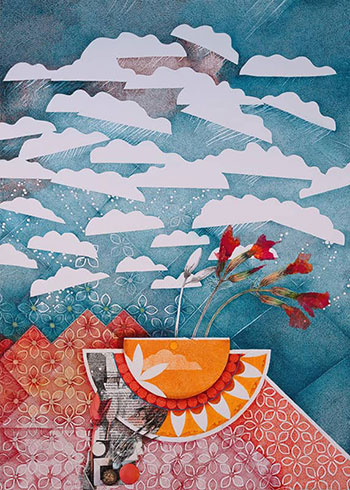
The titles of works in David Green’s fourth exhibition with Anthea Polson Art are cryptic. They and his creative procedure are imbued with Biblical nuances. When asked about them and his choice of subject matter he responded, “Why Noah and the flood? Working in small pocket sized drawing books I chase ideas about searching for possible outcomes and compositions. There are around fifty pages of fish drawings and I was attempting to find a format that could showcase them.” Because there were no fish aboard Noah’s ark, Green decided to design a new species of the forgotten creatures. “To do so I needed a coat hanger and what better one than the cataclysmic flood that covered the whole world? And thus my visual journey began.” Genesis-like, unfulfilling pieces are amended in a “gesso flood”. Akin to Noah’s ark and its passengers, the satisfactory bits “sail off into a new beginning.”
The abode in Buderim that he and Veronica Cay share is comparable to Noah’s ark for him. A leaking roof may epitomise the conundrums of cohabitation and art making priorities. The scenarios unfold “from the fishes Noah forgot through to Mrs Noah’s rescue plan for a leaking roof and her pre flood garden”. As nowhere in the Bible is Noah’s wife’s name given, Green chose not to disclose one either.
In describing the When It Rains The Roof Leaks image Green imparts, “The composition is part landscape and part interior. Perhaps the flowers on the table are from the garden Mrs Noah tends daily along with the cooking, the cleaning, the washing, the growing of the vegetables, as well as feeding the chooks and the goats. Maybe her roof and the sky both leak but the yellow flowers belong only to Mrs Noah.”
Green informs that the imagery in The Dancing Ghosts of Noah’s Flood refers to the environmental disaster a Biblical deluge would havoc. “This piece shows two hemispheres, hence the upside down trees bare of leaves and the scattered rocks and timber. However, should you look very closely and use your imagination, you will find four fishes almost completely hidden amongst the debris. In the trunks of the trees there may also be an animal or two hiding, not drowned but carried away amidst all the flotsam created by the flood.”
Signifying hope for the future, eleven small works on card depict blossoms from Mrs Noah’s garden afloat upon intricately delineated eddies and whirlpools. Of his and Veronica Cay’s collaborative artworks Green mentions that they have been doing such for a long time. “In this instance we decided a combination of her figurative pieces and my finely wrought pen applications would make a significant demonstration of two approaches – two styles unified in one work.” These shared renditions are visual elucidations pertaining to their musings on the cycles of life.
JACQUELINE HOUGHTON
After graduating from London’s Royal College of Art in 1964, David Green taught at Art Colleges whilst maintaining a freelance design and creative arts practice. Sponsored by the Australia Council, in 1976 he undertook a three-month lecture tour and workshop programme throughout Australia and New Zealand. Green emigrated to Australia in 1978 having accepted an academic position as a senior lecturer at RMIT Melbourne. Leaving RMIT in1985 he took up the position of Head of the School of Visual and Performing Arts at the now Charles Sturt University. Upon retirement and conferred with the title Emeritus Professor, Green relocated to Buderim where he was able to again immerse himself in his own art practice. He tells that after a lifetime of academe and administration, he found himself looking backwards and it was “logical to go to drawing”. Green is represented in many public collections including: the Power House Museum; Queen Victoria Museum and Art Gallery, Tasmania; State Craft Collection of Victoria; Ararat City Art Gallery; Albury City Art Gallery; Wagga City Art Gallery; Warrnambool City Art Gallery and Tamworth Fibre Collection. He is also the author of four books.
Receive e-mail updates on our exhibitions, events and more
Subscribe Now